
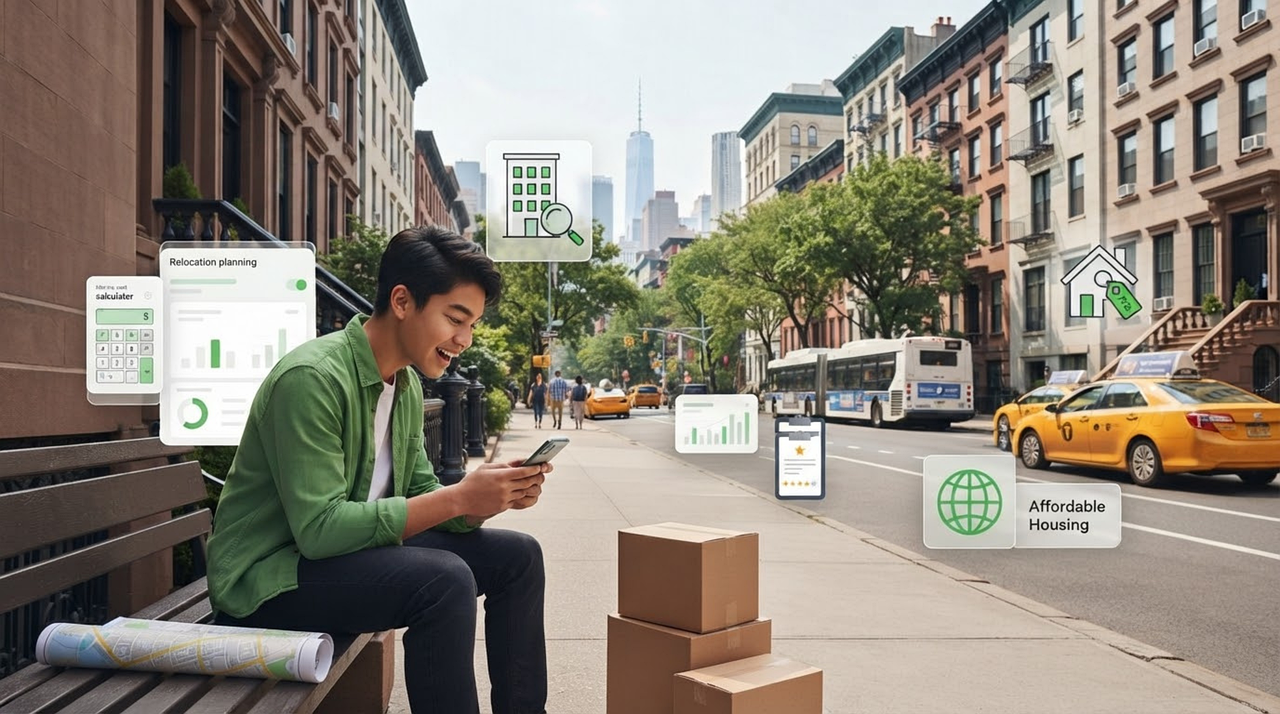
5 Free Tools to Use Before Moving to NYC in 2026
Moving to New York City is exciting, but there is a lot to figure out before you get there.
How much will the move cost? Is the apartment you found actually a good deal? How will you get around? Are there affordable housing options you may have missed? And where can you find reliable information about a building or neighborhood?
The good news is that you don’t need to pay for expensive reports or sign up for a dozen different services to start answering those questions.
Here are 5 free tools to use before moving to NYC in 2026 that can help you research your move, apartment, transportation, housing options, and the city itself.
1. Move-Price — Moving Costs and NYC Apartment Research
If you’re moving to NYC, one of the first things to figure out is how much the move itself is going to cost.
Move-Price’s free moving calculator lets you estimate your moving costs based on your route, home size, and belongings.
You can compare the estimated cost of using professional movers with DIY options, including truck rental and related moving expenses.
You can also build an inventory and add or remove individual items to see how your estimated cost changes. That’s useful because moving a lightly furnished one-bedroom apartment is obviously different from moving a packed three-bedroom home.
What else can you research?
Move-Price also has a free NYC Apartment Check for people who are considering renting in New York City.
You can use it to research an apartment building and look for information such as:
Building violations
311 complaints
Bed bug reports
Landlord complaints
Tenant complaints
Eviction history
Permits and active work
Crime around the property
Neighboring crimes from the past five years
Transit information
Public records
Landlord reputation information
The idea isn’t to automatically decide that a building is good or bad based on one record.
It’s about giving you more information before you sign a lease.
If you’re comparing several NYC apartments, checking the addresses before making a decision can help you spot things that aren’t obvious from a rental listing.
Try it: Free Moving Cost Calculator
Checking an apartment? Run a free NYC Apartment Check
2. NYC 311 — See What People Are Reporting
NYC 311 is one of the most useful free resources for researching New York City.
You can use it to find information about complaints and service requests across the city.
That can be especially useful when you’re researching a building or the area around an apartment you’re considering.
For example, you may want to look for complaints involving things such as noise, sanitation, heat, pests, construction, or other problems.
One complaint doesn’t necessarily mean there is something wrong with a building. NYC is a huge city, and buildings can have occasional problems.
What can be more interesting is seeing whether there is a pattern of complaints over time.
How to use NYC 311 before moving
If you’re seriously considering an apartment:
Search for the building or address.
Look at the types of complaints.
Check the dates.
Look for recurring issues.
Compare what you find with what the landlord or broker has told you.
You don’t need to spend hours going through every record. Even a quick check can give you additional information that you won’t usually find in an apartment listing.
Try it: NYC 311
3. MTA — Check Your Actual Commute
If you’re moving to NYC, transportation is going to become part of your daily life.
That’s why checking the MTA before choosing an apartment can be just as important as looking at the apartment itself.
An apartment may look great online, but a long walk to the subway or an inconvenient commute can become frustrating very quickly.
Use the MTA to research subway and bus routes and see how your potential apartment connects to the places you actually need to go.
Don’t just check the trip to work
If you’re comparing apartments, check several common trips:
Home to work
Home to school
Home to grocery stores
Home to major subway connections
Home to family or friends
Home to places you regularly visit
An apartment with slightly higher rent might make more sense if it saves you significant time and transportation hassle every week.
Before signing a lease, try checking the commute during approximately the same hours you expect to travel.
You can also check the MTA for service changes and other transit information before making your decision.
Try it: MTA
4. NYC Housing Connect — Check Affordable Housing Opportunities
Most people searching for an NYC apartment start with the usual rental websites.
But there is another option worth knowing about: NYC Housing Connect.
Housing Connect is the city’s platform for affordable housing opportunities, including affordable apartments available through housing lotteries.
This doesn’t mean you’re guaranteed to get an apartment. The application process can be competitive, and eligibility requirements vary depending on the property and household.
But if you’re moving to NYC and your budget is tight, it’s worth checking whether you qualify for any available opportunities.
Why check it before moving?
NYC rent can take up a large part of a moving budget, especially when you’re also paying for moving costs, deposits, furniture and other expenses.
Housing Connect gives you another place to look beyond the standard apartment search websites.
You can review available opportunities and check the eligibility requirements for apartments that interest you.
Even if you don’t find something immediately, understanding how the program works before you move can be worthwhile.
Try it: NYC Housing Connect
5. NYC Open Data — Dig Deeper Into the City
If you really want to research NYC before moving, NYC Open Data is worth bookmarking.
The city publishes thousands of public datasets covering different aspects of New York City.
It can be more complicated than the other tools on this list, but that’s also what makes it useful.
You can find datasets covering topics such as buildings, transportation, public safety, permits, property information, health and many other areas.
You probably don’t need to become an NYC data analyst before renting an apartment.
But if you’re researching a particular neighborhood or property and want to dig deeper, NYC Open Data can give you access to information that isn’t always obvious from a normal apartment listing.
A good way to use it
Start with a specific question rather than browsing randomly.
For example:
“What can I find out about this building or neighborhood?”
Then look for datasets that can help answer that question.
For most people, this will be more useful as a research tool than something they check every day.
Try it: NYC Open Data
How to Use These 5 Tools Before You Move
The real benefit isn’t any one of these tools.
It’s using them together.
Imagine you’ve found an apartment you like.
Step 1 — Check your moving cost
Use Move-Price to estimate how much it could cost to get your belongings to NYC.
Step 2 — Research the building
Use the Move-Price NYC Apartment Check and NYC 311 to look for building history, complaints and other information.
Step 3 — Check transportation
Use the MTA to see how practical your commute will be.
Step 4 — Check affordable housing
Look at NYC Housing Connect to see whether you qualify for any available affordable housing opportunities.
Step 5 — Dig deeper if necessary
Use NYC Open Data when you want to investigate public information about the city, property or neighborhood.
Together, these tools can give you a much better picture than an apartment listing alone.
Moving to NYC? Do Your Research First
Apartment listings are designed to show you why you should rent a place.
Your own research should help you figure out whether you actually want to.
You don’t have to spend hours researching every possible piece of information. Start with the basics, compare a few apartments, and investigate anything that raises a question.
And remember that public records don’t tell the entire story either. Visit the building, walk around the neighborhood, talk to the landlord or property manager, and see the apartment yourself whenever possible.
The goal isn’t to find a perfect building.
The goal is to know more before you sign the lease and start moving your life to NYC.
Quick List
Tool
What it’s useful for
Moving cost estimates and NYC apartment research
Complaints and service requests
Subway and bus information
Affordable housing opportunities
Public NYC datasets and deeper research
If you’re moving to NYC in 2026, these five free resources are a good place to start.